Sree Charani’s ice-cool control. Sheetal Devi’s relentless grit. Chess queen Divya Deshmukh unleashing gambits. In 2025, India’s young sportswomen didn’t just compete — they conquered. From Unnati Hooda and Tanvi Sharma ushering in a new era in badminton to the rise of another ‘Phogat’ — Suruchi — this time on the shooting range, Ankita Bhagat rattling South Korea’s archery dynasty, Preeti Panwar’s clinical power in the ring, or Antim Panghal reminding she still owns the mat. Express Sports dives deep into ‘Gen She’ – the trailblazers who kept the Tricolour flying high.

Divya Deshmukh has spent 2025 playing a rare brand of high-risk, high-reward chess. While the rest of the world is still gushing about her exploits from July in Georgia’s Batumi — where one by one she picked off World No.6 Zhu Jiner, veteran Harika Dronavalli, former women’s world champion Tan Zhongyi and, Indian chess legend Koneru Humpy, on her way to winning the FIDE Women’s World Cup title — those in the sport are still marveling at her decisions off the board that have marked her as an outlier.
Unlike most female players in the world, who play an occasional open tournament (with men in competition) in a year, Deshmukh has ventured off the beaten track at every opportunity she could in 2025. She played in four events this year where she went toe-to-toe with men: the Tata Steel Challengers at Wijk aan Zee, Prague Challengers, the FIDE Grand Swiss and the FIDE World Cup. She calls these “must-have” experiences, the way you would describe items on a bucket list during an excursion in a foreign country.
These forays into the open section have resulted in plenty of defeats for Deshmukh. At the Tata Steel Challengers at Wijk aan Zee she lost eight out of 13 games and then had five defeats from nine games at the Prague Challengers. But once she became a grandmaster in one shot thanks to winning the FIDE Women’s World Cup in July, she enrolled herself for some more ‘must have’ experiences: playing at the Grand Swiss and the FIDE World Cup in Goa, where she was eliminated in the second round itself.
“I don’t know if it’s her decision or her coach’s, but it’s extremely smart to play in these tournaments with top male players. It’s a very sticky subject in chess, but if you want to reach your absolute peak and you want to be as good as possible, you need to play against the best level of competition. Even if she’s struggling at times — and I think in Grand Swiss she lost quite a few games — she still is getting that experience. In fact, she had some opportunities to win some of those games,” says the World No.2 Hikaru Nakamura.
Like an AI model
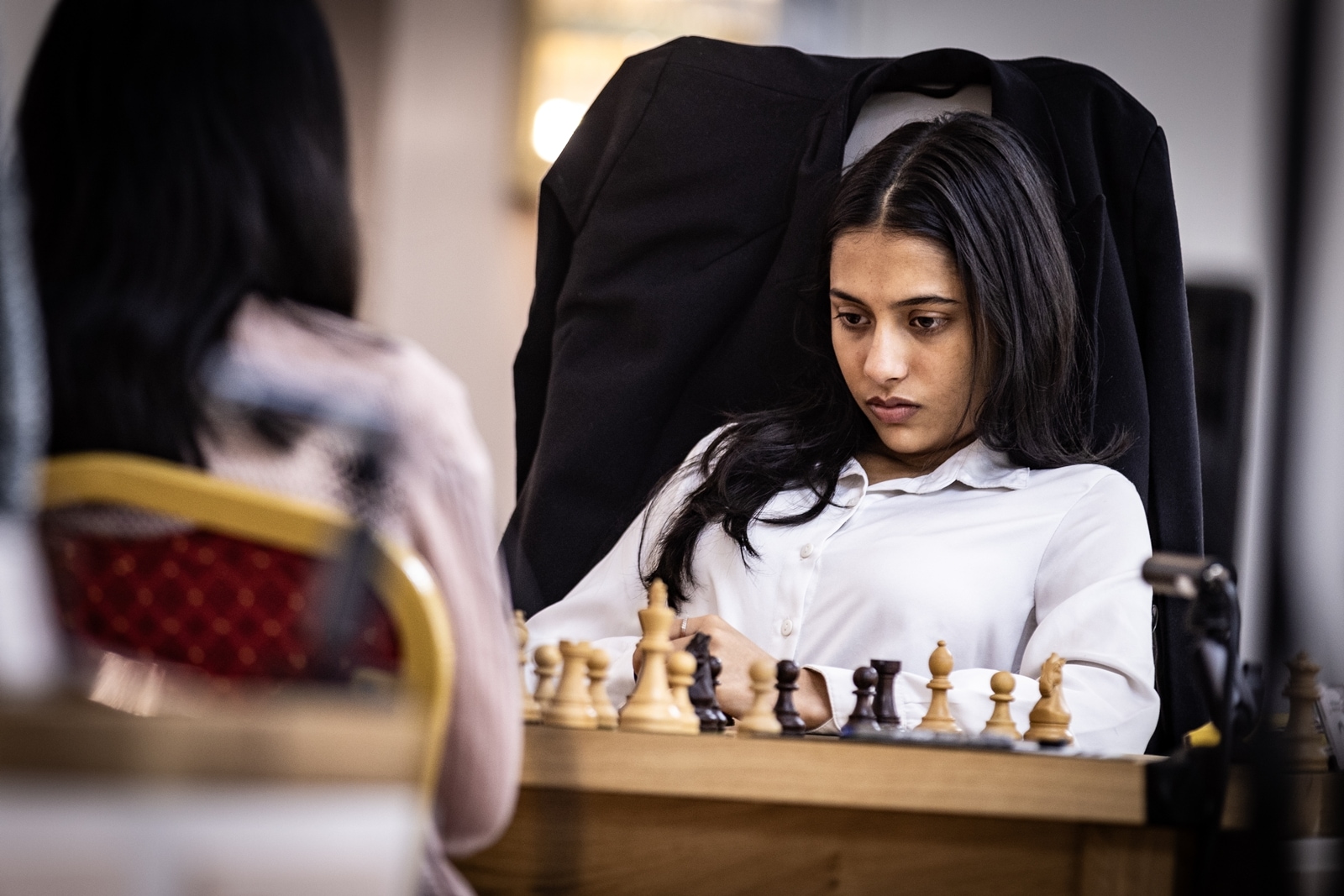 Divya Deshmukh has spent 2025 playing a rare brand of high-risk, high-reward chess. (Picture Credit: Anna Shtourman/FIDE)
Those who have worked closely with Deshmukh over the last few months warn that like an AI model constantly getting stronger, Deshmukh is still evolving.
“You can really see the transformation in her game: her weaknesses are slowly becoming less and less apparent. Her play’s becoming more stable,” says Abhimanyu Puranik, who has known Deshmukh for the past three years, and was recently revealed as a second behind her World Cup winning run.
Story continues below this ad
Puranik points out how Deshmukh’s game is becoming ‘more complete’ day by day. He reasons that when a player is young the moves often lack ‘refinement’.
“Your opening is just not as complete. You don’t know a lot of things. In the middle game and end game, you sometimes take too much risk. You calculate way too much, or way too less. It feels like she’s refining all of that,” says Puranik.
Puranik also points at her mentality as one of the reasons that give her an edge.
“She just raises her level in amazing ways. Maybe it’s sort of an inborn talent that whenever a situation is extra important, she will just raise her level. When she won the World Cup, I was not that surprised, because if you see, she played very well in the Olympiad last year. She has also won some very strong events like the Asian Championship and World Junior Championship,” says Puranik.
Story continues below this ad
He says that in chess one defeat can easily become two and two can spiral into a slide with a healthy dose of pessimism. But not with Deshmukh.
“She’s generally very stable in our approach, no matter how her performances are, she’ll have the same approach. That’s very hard to do because as soon as you have a few defeats you want to change things and in a drastic way,” adds Puranik.
Hou Yifan, arguably one of the greatest female chess players in history, also sees some traces of her personality in the Indian. Yifan gave up the Women’s World Champion’s throne to pursue other things in life like academics at Oxford University. Deshmukh, too, has repeatedly said that she does not think of herself as only a chess player.
Rather than join the chorus of admirers about her chess skills, Yifan says: “She’s very good. But what’s also important is that she has a passion for chess. She looks like she’s really enjoying playing chess. Her personality is also a plus. There are players who just take chess as a profession or as a job. It’s about the work hours, certain hours per day. To me that’s not okay.”
Story continues below this ad
Long-term benefit
Nakamura then takes a leap of imagination into the future and says that there is a chance that Deshmukh could be fighting it out for the Women’s World Championship title some day, where she could likely find the two Chinese stars, Zhu Jiner and current women’s world champion Ju Wenjun standing in her path to the throne. He then points at Deshmukh’s other compatriots.
“What really sets her apart when I look at Humpy, for example. I don’t remember Humpy really playing in men’s events in the last decade or two even though she was very clearly the best female player in India. Same goes for Harika. I can’t really recall her playing that many tournaments besides a couple of open tournaments she played. The fact that Divya is doing that can only have long-term benefits. Even if it’s unfortunate that she’s lost a lot of games right now, that will improve her level,”adds Nakamura. “Among the players outside of the Chinese, I think she’s probably the best right now. Vaishali may be close behind, but I feel like Divya, being quite a bit younger, has a lot more room for growth.”
And that should be a scary prospect for the rest of the sport. Women and men.