While a lot of focus and attention has been on India’s batting line-up that breathes intent from top to bottom, enabling them to play a brand of cricket that puts you on the edge of your seat, there is something even bigger unravelling in the bowling department. In a format where batters tend to win matches, all successful teams in T20s – international and franchise cricket – have one element in common: the presence of an equally strong bowling attack. For a team that is aspiring to defend the T20 World Cup, India have taken all the possible steps to strengthen the team from the one that won the title in the Caribbean and USA in 2024. For an attack that already had Jasprit Bumrah, Arshdeep Singh and Kuldeep Yadav, they have added Varun Chakaravarthy, with Axar Patel already being part of the mix. For a World Cup at home in two months, that’s an attack to be envious of, more so if one factors in the spin resources.
Story continues below this ad
In a tournament where India’s spinners, with Washington Sundar also in the mix, are expected to call the shots, there is every reason to be worried about Arshdeep and Bumrah. In the age of match-ups, it is a dream combination to have. Hardik Pandya’s presence, if fit and available, has all the potential to put the opposition’s plans to the bin. It is well known that India prefers flexibility in the batting order, where, apart from the openers, the rest are fluid. In head coach Gautam Gambhir’s assessment, batting orders are overrated in white-ball cricket. The shrewd tactician he is when it comes to T20 cricket, especially if India play their bowling cards smartly, they have a glorious opportunity to gain an edge even before they take the field.

Trump cards

In that regard, Arshdeep and Bumrah are the trump cards with the ball. The left-arm seamer, with the banana in-swing in armour, can be banked on to land the early blows. When the white Kookaburra swings, the Punjab seamer doesn’t do anything extraordinary. He sticks to pitching it up, and the movement on offer is usually enough to get the job done. Like Mitchell Starc, who has the knack of striking in the first over, Arshdeep is quietly making a reputation of his own. Since Bhuvneshwar Kumar faded away, India haven’t had a seamer whose swing becomes unplayable. Across all T20s, he has 84 wickets in the powerplay at an economy rate of 8.12 in an era where most teams come out in top gear in the first six overs. Bumrah has 70 in the same period, at a miserly economy of 6.50.
Story continues below this ad
Their early strikes mean the spinners more often than not tend to bowl at new batters. Given the variations up their sleeves, incoming batters invariably take time to navigate through them. It is what unfolded at the Barabati Stadium, where after Arshdeep removed Quinton de Kock and Tristan Stubbs, Axar straight away got off the mark before Varun bounced back against new batters.
Axar-Varun axis
Their exceptional skills at the death, coupled with Pandya’s presence, gives India an opportunity to extract the maximum from their two premier pacers. In case Pandya happens to take the new ball or the spinners happen to come early, which has been the case in recent times, where Axar and Varun have got an over each, it leaves India with four overs of Arshdeep and Bumrah at the death. Despite his improved show with the new ball, Arshdeep’s ability to land yorkers and use the cutters at the death hasn’t diminished. He has 104 wickets in the death overs, with definite scope to improve on his economy, which stands at 9.46 – a number too high for a bowler of his calibre. Bumrah, needless to say, is exceptional in the death over phase with 132 scalps coming at an economy of 7.88.
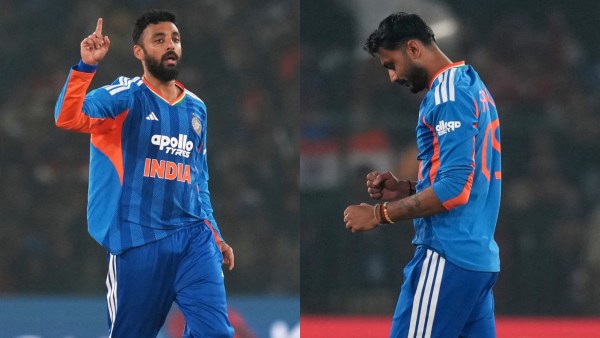 Indian spinners Varun Chakaravarthy and Axar Patel in action during first IND vs SA T20I in Cuttack. (PHOTO: AP)
At the T20 World Cup, India have two golden geese in the pace department. If Pandya is fit, it will provide India a luxury that others don’t have. If Arshdeep and Pandya share the new ball, India can save up Bumrah for the second half. At the Mumbai Indians, there have been instances where they held back Bumrah for later stages. From applying breaks in the middle-overs to bowling at the death, Bumrah had no trouble excelling. Moreover, he comes across as a bowler who seems more comfortable with bowling with an older ball.
If India can use these two trump cards well, it could all spell doom for opponents at the top and at the death.