Patience is the most important virtue of a spinner. Unfortunately, it has been missing among our spinners, and that’s what I’ve been witnessing of late, especially on turning tracks, not on rank turners. I can see a couple of reasons. A) Our spinners don’t bowl enough in our conditions in domestic tournaments. B) The influence of white-ball habits. A spinner matures with not only age but also with the overs he sends down. When you bowl longer, you gain maturity and develop patience, which is absolutely necessary.
In India’s case, we are speaking not about spinners, but all-rounders like Washington Sundar and Axar Patel. They have been quite good and effective with the white ball. But when it comes to red-ball cricket, they hardly have the experience on such pitches on the domestic circuit. When you play on pitches that have a bit of help for spinners, you know exactly what is happening and what skill is required. Previously, we had pitches that were good for batting on the first couple of days, and it started to assist spinners from the third or fourth day. Those pitches were dry as well. So it helped you grow as a spinner. You would show patience, and towards the end, you went for the hunt.
When the foreign spinners come here, they don’t do anything extraordinary. We have seen Nathan Lyon, Ajaz Patel and now Simon Harmer. They keep bowling those consistent lengths over after over by keeping it simple. With India, when we play three or more spinners, one of them doesn’t bowl for a long time. It has been our tradition for several decades, where, as a spinner, you used to have the ball in your hand for a long time. But when you play three spinners, it is impossible. You invariably start looking for wickets, and you keep shuffling them. It leads to, even if they want to attack, a defensive field trap. They are extremely good at playing the containing role. But wicket-taking ability is missing.
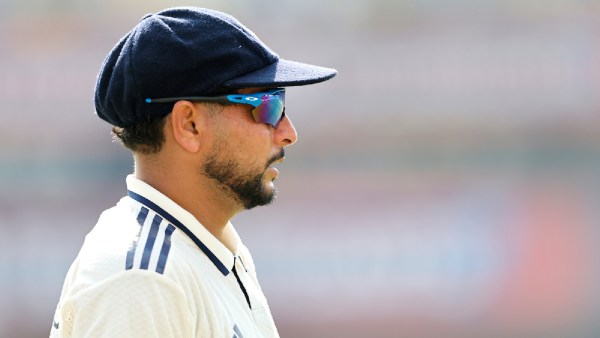 Kuldeep Yadav of India during the Day 1 of the 2nd Test match between India and South Africa at ACA Stadium, Guwahati, India, on November 22, 2025. (CREIMAS for BCCI)
The Kuldeep conundrum
In overseas conditions, he keeps missing out because someone else bats better than him. When he is not picked, he should be released to play matches elsewhere, like county or Ranji, because when Test cricket is underway, the domestic season is also underway wherever you play. It is better than warming the bench and just bowling in the nets. You need to keep the rhythm going. When you don’t do that, you can’t expect him to just turn up and win matches for you. When he plays, there are at least two, or in some cases three, alongside him. Since you have multiple options, he doesn’t get long spells.
Not too long ago, Ravindra Jadeja was unplayable in Indian conditions, and I feel this is where India are missing R Ashwin. Spinners hunt in pairs. At one end, we had Ashwin challenging the batsmen with his variations, and at the other end, you had Jadeja consistently hitting the right lengths. When there is pressure at both ends, it is a totally different ball game. Ever since Ashwin retired, the others around Jadeja are playing a containing role, which means batsmen require just a little bit of skill to second-guess. Since the influence of T20 is too much on them, we don’t see them deceive batsmen through the air.
Inexperience speaks
In Kolkata and Guwahati, we played on contrasting pitches — one was black soil, and another was red. Depending on the soil, you need to make certain tweaks. For example, on red soil you should bowl a lot slower because it has to grip and turn. The trajectory has to keep changing. Length becomes crucial. It just can’t be bowling quick and bowling up. The speed has to be in the 70-80kph range. You will know this only if you play domestic cricket regularly because each pitch is different.
Story continues below this ad
Here is where we should look at the pitches in the domestic circuit. We play on green tops or on paata tracks. It means you don’t get to face quality spinners even in the domestic circuit, and when you go to the Test level, there is a huge jump in terms of quality. When you play even on a slightly green top, the moment a spinner tosses the ball, batsmen will jump out and hit him out of the park.
Moreover, it is a concern that we don’t have quality off-spinners and wrist-spinners coming through the ranks in red-ball cricket. Thanks to the reverse-sweeps and switch-hits, they rely a lot on over-spin because the off-spinner’s field is totally different. You need captains who understand that as well. The time has come for the BCCI to have special camps for red-ball spinners at the Centre of Excellence. To have quality spinners, you need to create the right environment, which I feel is missing now.
(The author, a former India spinner and selector, spoke to Venkata Krishna B)