Amidst the pandemonium that unfolded in Kolkata, Lionel Messi would have found a strange connection with a humid night in Santa Fe, one and a half decades ago. In the vast arena, the nearest international stadium to his hometown Rosario, he saw enraged masses peel off his posters, the audience breaking chairs and jeering him. He slumped to the turf, weary with the burden of a country, as the symbol of a nation’s collective failings, after the Copa America game with Colombia ended goalless.
At the Salt Lake Stadium, ten thousand miles away from Santa Fe, he was a symbol of another multitude’s frustration, the collective angst that the deity they love didn’t reciprocate their devotion. That he didn’t reciprocate their love; that he was acting to the pre-scripted notes of a PR pro, that he was just a human mannequin waving his hands at the crowd, without love or care. The root of the chaos, as much as the organisational ineptitude, was the sense of betrayal. After all, the fan futilely believes that the emotional connection is mutual. It’s akin to visiting any crowded Indian temple, where the devotee can’t have enough time to unload his grievances to the stone idol.

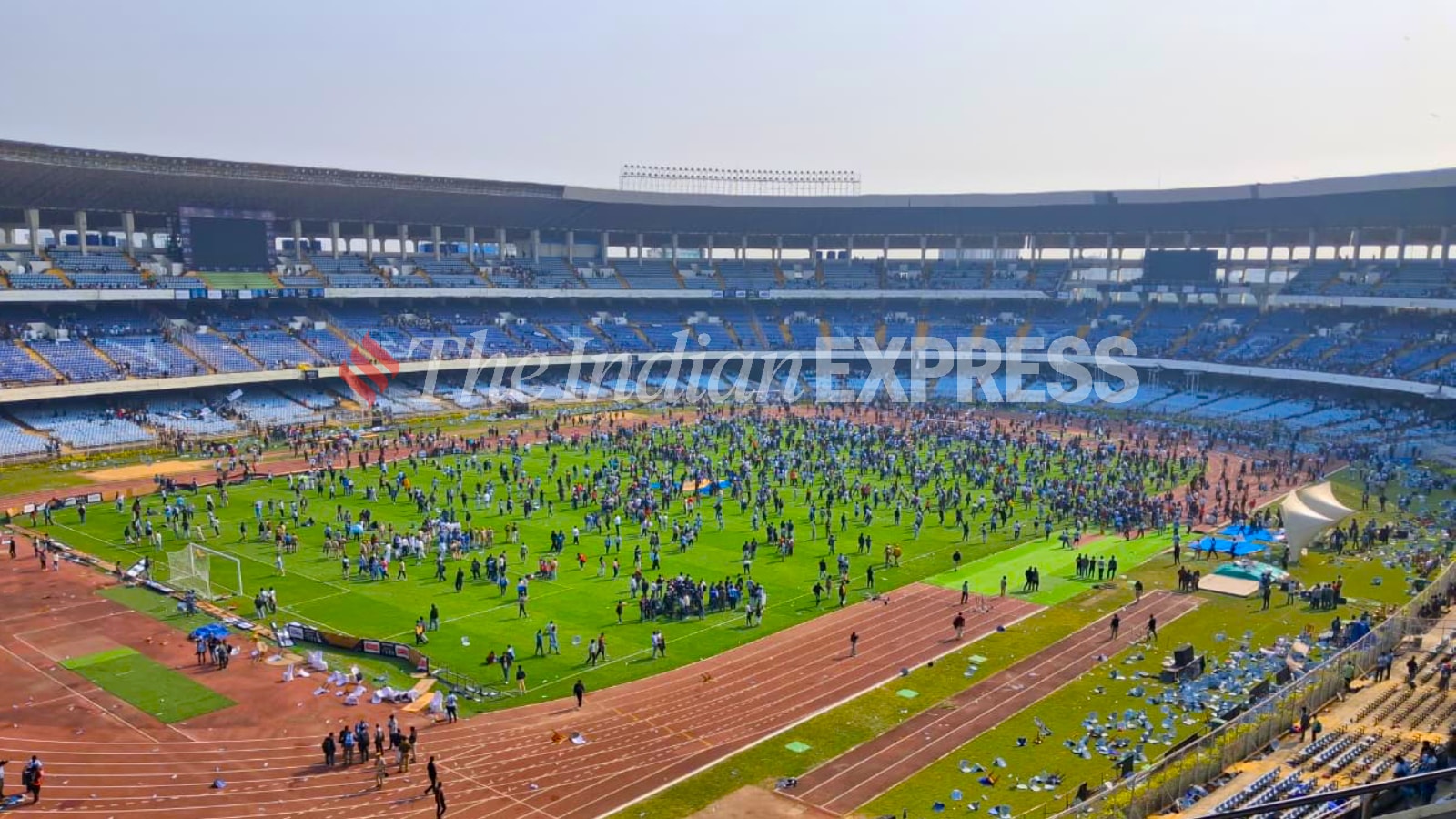 Angry fans in Kolkata invade the pitch at Salt Lake Stadium after Lionel Messi left after a brief appearance during the GOAT Tour. (Express Photo by Partha Paul)
But it’s how deeply attached and emotional crowd behaves, the interactions with the idol, god or human, becomes an intimate, personal experience. In Kolkata perhaps, Messi could see the angry fans he once saw in Santa Fe. Or in Paris, or in Barcelona when he decided to end the most glorious chapter of his career, or every time he let the national team down, even if the national side had put him down. It mattered for the crowd because it was Messi. The heart would not have bled profusely had it been Kylian Mbappe, Luka Modric, or even his greatest contemporary Cristiano Ronaldo. Messi, India and Argentina are bound by an ineffable thread.
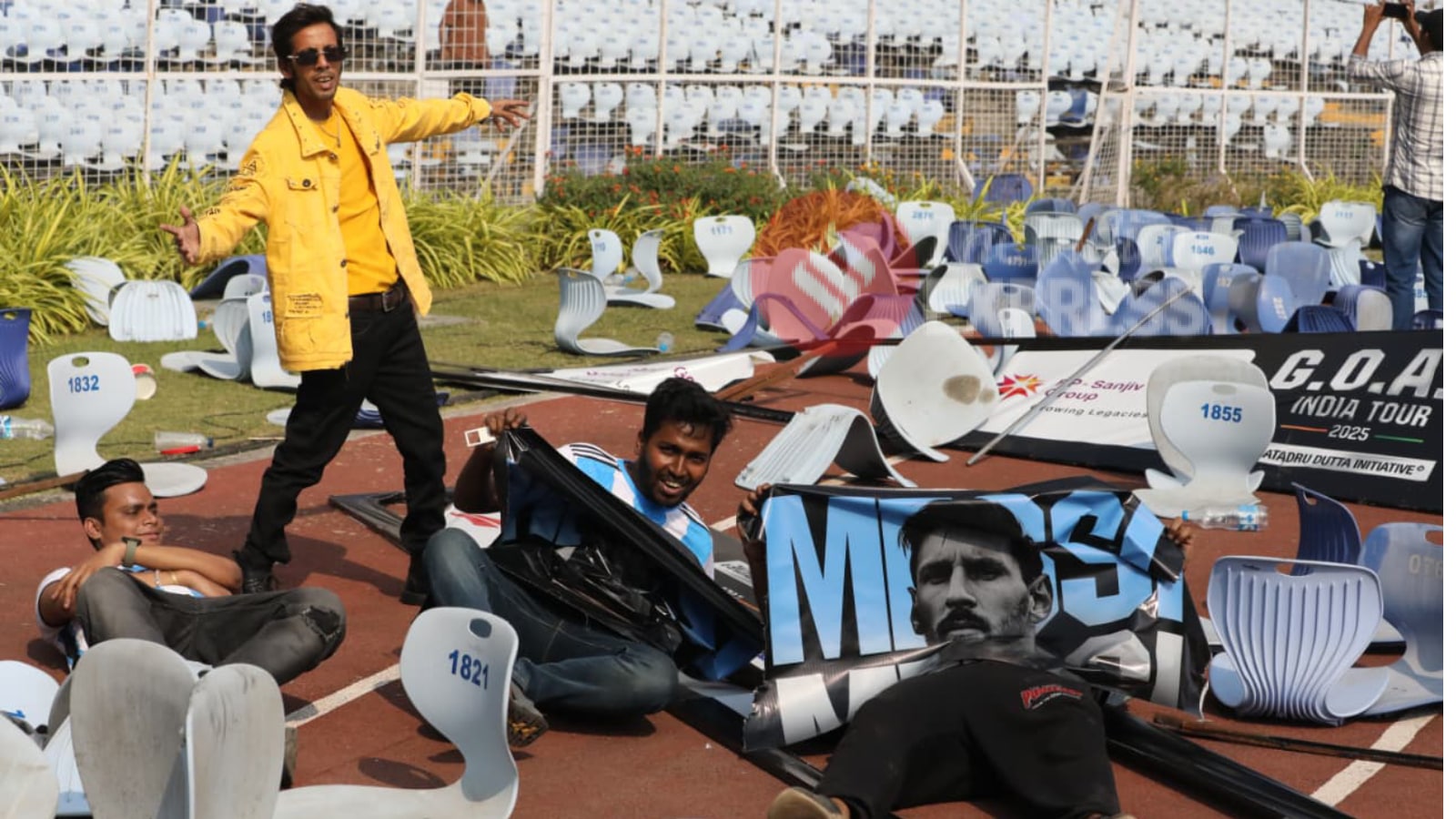 Fans pose amidst the ruins of banners and chairs during the Kolkata leg of Lionel Messi’s GOAT Tour inside the Salt Lake Stadium. (Express Photo by Partha Paul)
The three have little mutual tastes, no shared geography or language or ideology or sporting rivalry, or even colonisers, even though the influential British traders established a cricket club in Buenos Aires much before they brought football. The first Argentine hero in India was not a footballer, but the revolutionary Che Guevera, who visited India in 1959 with Fidel Castro. But his popularity was confined to subaltern left circles and had not yet to adorn T-shirts or wall graffiti or become a pop-culture icon (an idea he would have rebelled against). Che was from Rosario, and like Messi found more acceptance (until the 2022 World Cup) triumph abroad than at home. An Argentina side comprising luminaries Jorge Burruchaga, Ricardo Giusti and the legendary manager Carlos Bilardo featured in the 1983-84 Nehru Cup at Eden Gardens. Two years later, Burruchaga would score the winner in the 1986 World Cup final, the tournament that pulled India closer to Argentina. The magnet was Diego Maradona.
There were international football heroes that India admired before Maradona. Pele and Garrincha; Franz Beckenbauer and Ference Puskas. But none was deified as much as Maradona, celebrated as much for the magic his feet designed as for the madness his head conceived. He was what every football fan or player in the country wanted to be, yet knew he could not be. He was one among them, flawed and rebellious, short and scraggly haired, from the streets and all naturally trained; yet he was someone elusive, someone from the dream, some from the pages of Jorges Luis Borges, the greatest Argentinian writer (who though once snubbed football: “soccer is popular because stupidity is popular”).
To the altar of Che and Maradona, entered Messi, sometime in the mid-aughts. He was different from both, fiercely god-fearing, almost saintly disciplined and a product of structured training, a cigar doesn’t play on his lips, even though he often walks away with the proverbial “cigar”. The influence of Che and Maradona echoes in Messi’s life. He often wore Che and Maradona shirts under his jersey. “I get excited when I see shirts of Maradona or Che Guevara anywhere. It’s a beautiful feeling,” he would say.
By that time, European football has barged into India’s television space. They could watch Messi every single week; they could trace every stage of his, track every rung of his evolution, or recount every goal he scored. They penned him poems, raised billboards and erected statues. No Indian football figure could ever match the sheer love he generated. He stopped a country languishing 142nd in the world, or has never qualified for a World Cup. His popularity in India matched those of the cricketers. His shirts sold as much as those of Virat Kohli and Rohit Sharma.
Story continues below this ad
But in him, India found contentment. As though Messi’s World Cup triumph was theirs too; Maradona’s death was mourned like the passing of their own close relatives. The fans’ resentment in Kolkata was, thus, not an isolated event of fan outrage, but once that has deeper sentiments. It was not Messi that betrayed their feelings, but the PR firms that brought him here. In their agitated eyes, Messi could have sensed it in the eyes of mutinous fans in Santa Fe a long ago. A slice of his own country even.