The day before potentially the most defining game of his career, Pakistan captain Salman Ali Agha was relaxed, even cheerful, when addressing the media. After the early looseners, he knew tougher questions would arrive. So it did. When the handshake question that occurred three weeks ago dropped, he did not flinch, but with half a grin, he replied: “I have been playing professional cricket since 2007, under-16 and all that stuff and I have never seen teams not shaking hands,” he said.
He remembered his father, with whom he started watching the game. “My father is a big cricket fan and I speak cricket with him. I have heard a lot of stories from him but he has never mentioned a match where players have not shaken hands. Even when the (diplomatic) situation was worse, players from India and Pakistan have shaken hands. It is not good for the game,” he said.

Talks invariably flowed to the gestures of Pakistan’s seamers on September 21.Haris Rauf mimicked crashing planes and gestured 6-0 at the crowd, hinting at India’s fighter jets Pakistan Army claimed to have shot, Shaheen Afridi exchanged bloodshot stares with India’s openers Abhishek Sharma and Shubman Gill.
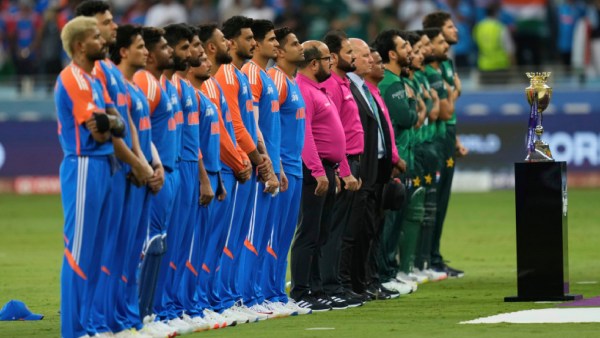 Pakistan and Indian players stand for national anthem before the start of the Asia Cup cricket match between India and Pakistan at Dubai International Cricket Stadium in Dubai,United Arab Emirates, Sunday, Sept. 21, 2025. (AP Photo/Altaf Qadri)
“Every individual has a different way of expressing aggression. If you ask fast bowlers to be not aggressive, there will be nothing left in them. They need that bit of aggression to fire them up, to keep them up and running. I give a free hand to the player. They can handle their emotions. I am fine with them showing emotions and aggression as long as they don’t disrespect their opponents. If an individual wants to be aggressive, I have no problem with it, whether it is my team or the other team,” he said.
Rumours had swirled that the captains would not do the pre-final photoshoot. Salman looked puzzled when the question was shot at him. “It is the protocol. If it is there, we will definitely do it. There is nothing wrong with it. Whether they come or not, what can we do about it,” he asked. The media manager clarified that the shoot will happen before the toss and not the day before the final, as it often happens during World Cup matches.
No question provoked him nor did he fire verbal salvos at Suryakumar or the Indian team. When suggested that India could feel more pressure than him, in the backdrop of the handshake-storm they instigated, he refuted it. “Pressure would be there for both sides in an India-Pakistan final. I don’t think we will have less pressure and they will have more. Finals are always different. Mistakes will happen, whoever makes fewer mistakes will win the match. We lost the last two games against India because they made fewer mistakes. On Sunday we will look to commit fewer mistakes,” he said.
He was probed on his personal form, especially his meagre haul of 64 runs six innings and a horrendous strike rate of 78. “I know (his form) I am not up to the mark and I am working hard on it. Regarding strike rate, I am not saying it is not important. But you should assess the situation of the team and conditions too. You don’t need to bat at a strike rate of 150 on every pitch. At the end of the day, you have to see what the team wants and what the situation demands,” he said.
Story continues below this ad
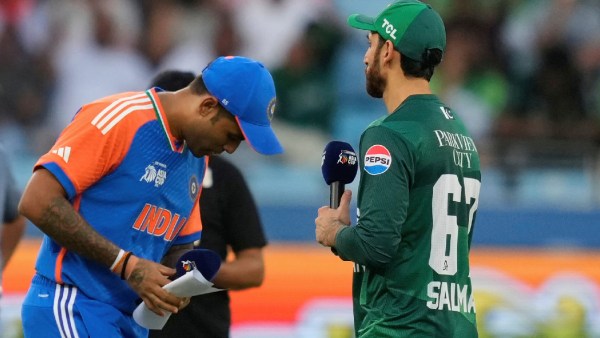 Suryakumar Yadav and Salman Agha at toss. (AP photo)
He also asserted that he and his team has shut out from all the outside chatter. “We cannot control what they say or write. We will try to control what we can. What the media says makes no difference to us. We have come here to win the Asia Cup and will try to do that. If we play to the best of our ability, ” he asserted.
About his misfiring batsmen, including himself, he said: “It is everyone’s responsibility. They all know they have not been performing at their best, but everyone is trying, everyone knows. Hopefully, they are all waiting for the final to produce their best.” In almost every game, they had experienced collapses, only to be rescued by the lower-order batsmen. Against Bangladesh, they were 49 for 5 before the lower order retaliated and dragged them to 135, and defended it by 11 runs,
Most conspicuous has been Saim Ayub’s form–he has collected four ducks in six innings. But Salman backed him, as he had throughout the tournament. “He is one of such talents that can play the next ten years for Pakistan. You have to wait and back him until it comes to a point where he has to be changed. But when you look at it, he has been contributing with the ball and on the field. He has contributed in every game,” he pointed out.
The only questions he dead-batted were those that related to strategies. “Strategy mein idhar kyu batheyega? (Why would I tell them here?)“ he would ask with a mischievous smile.