He recognised the potential of Olympic sport when few in India did, built national and international events that still anchor the sporting calendar, and brought some of the world’s biggest names to Indian arenas. That legacy, however, was irrevocably stained by corruption allegations that led to his arrest and eventual fall from power.

A career politician, Kalmadi’s first major foray into national-level sports administration was in 1987, when he became the president of the Athletics Federation of India, a position he held for 19 years. He assumed an even bigger role in Indian sport after he was elected as the Indian Olympic Association chief in 1996, marking the beginning of an uninterrupted 15-year tenure. It was in these roles, which he held simultaneously, that Kalmadi left a tangible impact on the sporting scene.
In his capacity as the athletics head, Kalmadi – a multiple-time Lok Sabha and Rajya Sabha MP – brought some of the biggest international track and field stars for eight competitions in New Delhi from 1989 to 1998, including the Asian Championships for the first time in 1989. Among them was track legend Carl Lewis, who was paid substantial appearance fees to compete in India and boost the sport’s profile. Kalmadi, who went on to become the president of the Asian Athletics Association, also launched the Asian Grand Prix meet in 1990.
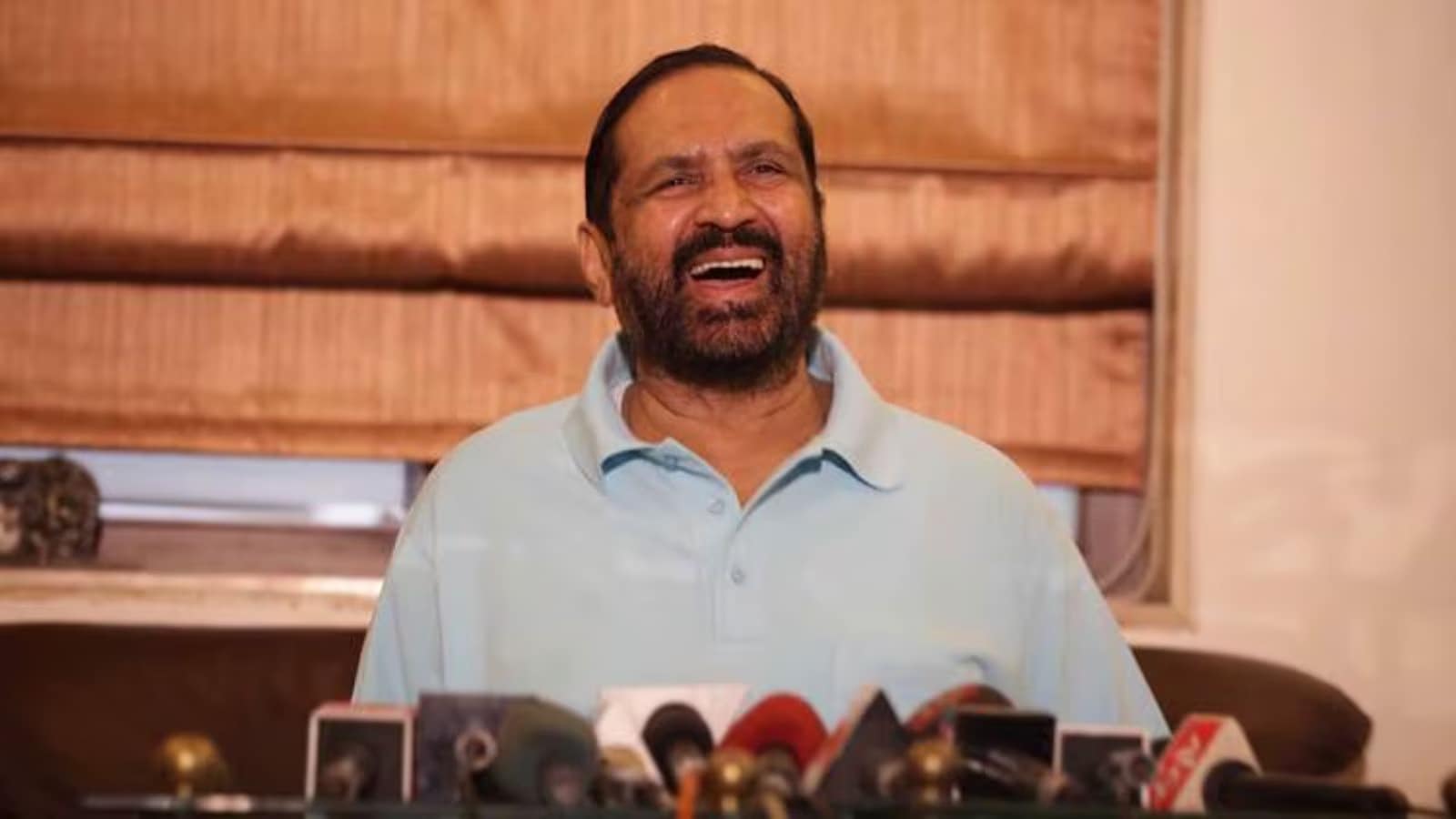 The National Games became an important stepping stone for Indian athletes, and Kalmadi managed to organise them at regular intervals in Pune, Bengaluru, Chandigarh, Hyderabad, and Manipur. (File)
As the IOA chief, old-timers in the sports administration credit a resourceful Kalmadi – who served in the Indian Air Force from 1964 to 1974 – with reviving the National Games, which were not held for six years after 1987.
Lalit Bhanot, who was the secretary general of the 2010 Commonwealth Games Organising Committee when Kalmadi was its president, called him a ‘visionary’. “As a sports administrator, he was a visionary and brought about positive changes in Indian sport, including the hosting of the Commonwealth Games, the Afro Asian Games and the National Games regularly. He was also a hard taskmaster, ensuring the work was completed on time and in the best possible manner. He was open to listening to sportspersons,” Bhanot told this newspaper.
The National Games became an important stepping stone for Indian athletes, and Kalmadi managed to organise them at regular intervals in Pune, Bengaluru, Chandigarh, Hyderabad, and Manipur.
Story continues below this ad
“He also got the central government on board in terms of helping set up infrastructure in these states. So, infrastructure was built in Manipur, Guwahati and Punjab to promote sports. These were disturbed areas during that period. He believed the National Games were important because they provided competition for athletes and also ensured infrastructure was built for future generations,” Bhanot added.
Kalmadi, during whose tenure independent India won its first individual Olympic gold medal in 2008, then made India the destination for major multi-disciplinary events, including the 2008 Commonwealth Youth Games in Pune and the 2010 Commonwealth Games in New Delhi.
On the field, India recorded its best-ever performance at the CWG in 2010, winning a total of 101 medals, including 38 gold. Although a sporting success, the Games eventually led to his downfall after the Kalmadi-led organising committee was accused of organisational failures and mired in corruption scandals.
So dire was the legal mess left by the scandal-ridden event that, according to a 2020 Indian Express report, even after 10 years since the closing ceremony, more than 50 cases were pending before various courts and in arbitration. Kalmadi was arrested in April 2011 and released after nine months in prison. However, in April this year, the Enforcement Directorate filed a closure report in the case, giving him a clean chit.
Story continues below this ad
Said Bhanot: “When India hosted the Commonwealth Games in 2010, one of his main objectives was that India should also win medals and not just conduct the Games. And we won over 100 medals (101). For this, the government had given a grant of Rs 600 crore for the preparation of Indian athletes. His contribution to uplift Indian sports must be remembered,” Bhanot said.